Quick answer
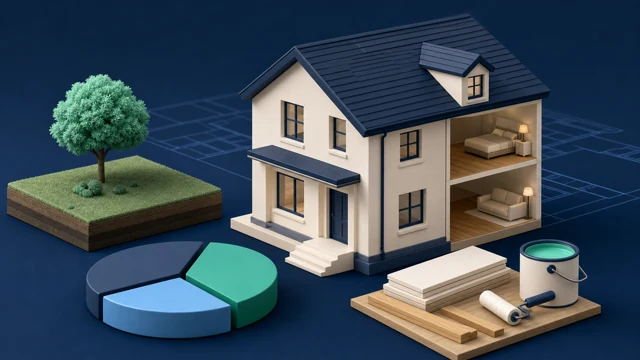
A purchased rental property generally starts with cost basis, including qualifying acquisition amounts. Allocate the combined cost between land and depreciable buildings using supportable relative values. Then track increases such as capital improvements and decreases such as allowed or allowable depreciation to determine adjusted basis.
Basis is different from equity
Equity is a financing concept: property value minus debt. Basis is a tax concept used for depreciation, casualty calculations and gain or loss. Paying down the mortgage increases equity but does not generally increase tax basis.
Market appreciation also does not automatically change basis. Basis changes through specific tax adjustments and transactions.
Build the initial cost file
Purchase price is the starting point for many acquisitions, but certain settlement and acquisition costs may be added to basis while other items are currently deductible, amortized or excluded. Escrow deposits for future taxes and insurance are not purchase basis.
Keep the closing statement, deed, contract, appraisal, legal invoices and allocation workpapers. The tax treatment of each closing line should be reviewed rather than applying one percentage to the entire statement.
Separate land from buildings
Land is not depreciable, so a combined purchase must be allocated between land and building. IRS guidance permits allocation using relative fair market values, and assessed values may be used as a basis for allocation when fair market values are uncertain.
A tax assessment is not automatically the only correct method, but the allocation should be reasonable, documented and consistent. Special components or personal property can require additional analysis.
Track improvements and depreciation
Capital improvements generally increase basis and are recovered through depreciation or upon disposition, subject to the applicable rules. Repairs may be currently deductible when they do not need to be capitalized.
Adjusted basis is reduced by depreciation allowed or allowable, not simply the amount the owner remembers claiming. Errors should be addressed with a tax professional rather than ignored until sale.
Conversions, gifts and exchanges need special rules
When a former personal residence becomes a rental, depreciation basis can be limited to the lower of adjusted basis or fair market value at conversion. Inherited, gifted and exchanged property can use other basis rules.
These situations are especially important because a wrong starting basis can affect years of depreciation and the eventual gain calculation. Obtain professional advice and preserve valuation support.
Rental Property Basis Calculation checklist
- Save the complete acquisition closing file
- Classify each settlement cost
- Allocate land and building with support
- Add capital improvements by date and asset
- Track cumulative allowed or allowable depreciation
- Update basis after exchanges or casualty events
Frequently asked questions
Is my mortgage balance part of basis?
Debt can be part of the acquisition consideration in some transactions, but later loan balance is not the same as adjusted basis.
Can land be depreciated?
No. The cost allocated to land is generally not depreciable.
Does a new roof increase basis?
A roof replacement is often a capital improvement, but current tax regulations and facts determine treatment and recovery period.
Research transparency
How this guide was prepared
This guide summarizes publicly available U.S. government, regulator or industry-source material listed below. It explains planning concepts and questions to verify; it does not provide a property-specific quote, inspection, coverage decision, legal opinion or tax advice.
Sources and references
- Residential Rental Property, Publication 527 — Internal Revenue Service
- Basis of Assets, Publication 551 — Internal Revenue Service
- Tangible property regulations — Internal Revenue Service
Sources were checked for this guide on July 27, 2026. Policy terms, tax rules, insurance forms, incentives and local requirements can change.
General-information disclaimer
This guide is for general planning only. It is not a quote, policy interpretation, legal advice, tax advice, engineering advice or a substitute for a licensed professional who can review your property and documents.